Why every dealership will run an AI agent by 2027
Walk a dealership floor at 6:45pm and you'll see the problem nobody put on a spreadsheet. The last salesperson is finishing a deal. Three website chats are open. Two text leads came in during the test drive that just ended. A fourth shopper is on a competitor's site right now, asking that store's chat whether the silver SUV is still available. By morning, the leads that didn't get an answer tonight are colder, and one of them already bought somewhere else.
This is not a staffing failure. It's a structural one. A car dealership runs on human attention, and human attention is expensive, finite, and asleep by 9pm. For two decades the industry papered over the gap with faster CRMs, BDC teams, and auto-responders that fooled no one. None of it solved the core issue: the moment a buyer is ready to talk almost never lines up with the moment your team is free to talk. Agentic AI finally does, and that's why the agent is going to become as standard as the website itself.
The math of the first reply
Every study of online lead behavior lands on the same uncomfortable finding: speed dwarfs almost everything else. Contact a lead within five minutes and you are many times more likely to reach and qualify them than if you wait thirty. Wait an hour and the odds fall off a cliff; wait until the next business day, as a huge share of after-hours leads effectively do, and you're often paying to acquire a lead you never actually engage.
Now layer in when car leads arrive. They spike at night, on weekends, and during exactly the busy showroom hours when your team has the least slack. The result is a cruel overlap: your highest-intent moments collide with your lowest-availability moments. A human BDC can shave minutes off response time during business hours. It cannot be awake at 11:40pm for the buyer comparing payments before they fall asleep.
The dealership that answers in thirty seconds at midnight isn't competing on price. It's competing on being there — and right now, almost nobody is.
An agentic AI sales concierge closes that overlap completely. It answers in seconds, every hour of every day, in your brand voice, grounded in your live inventory. It doesn't get tired at the end of a long Saturday. It doesn't forget to follow up. And critically, it doesn't just reply — it moves the deal forward.
"Chatbot" is the wrong mental model
Most dealers' instinct is to picture the clumsy scripted chatbots of 2018 — the ones that looped "I'm sorry, I didn't understand that" until the customer rage-closed the tab. That memory is doing real damage, because it's causing stores to dismiss something categorically different.
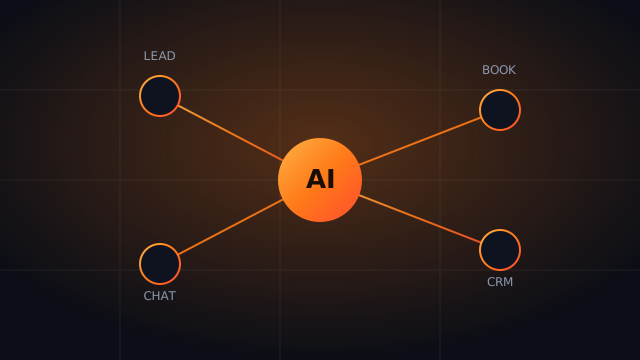
The distinction that matters is the word agentic. A chatbot answers questions. An agent completes tasks. Ask a modern agent "is the silver Highlander still on the lot and what would my payment be with $3,000 down?" and it checks real inventory, applies your financing rules, gives a straight answer, and offers three test-drive times that are actually open on the calendar — then books one and drops the qualified lead into your CRM with the full transcript. The customer experienced a conversation. Your team experienced a booked appointment appearing on the schedule.
That's the leap. The agent is not a deflection layer to keep customers away from your people. It's a pipeline that hands your people more qualified, better-briefed conversations than they could ever generate by hand.
What it actually does on the floor
- Answers every channel instantly — website chat, text, and form fills get a real reply in seconds, day or night.
- Knows your real inventory — it never pitches a unit you sold this morning, and it can compare trims and surface alternatives.
- Qualifies without interrogating — it gathers trade, timeline, and financing context conversationally, so your salesperson opens with leverage.
- Books the next step — test drives, appraisals, and finance calls land on the calendar instead of in a follow-up queue.
- Hands off cleanly — the second a human touch matters, it routes to the right person with the whole context attached.
The economics nobody argues with
Set the technology aside and look only at the money. A dealership already pays for the traffic — the SEO, the paid search, the third-party listings, the brand spend that makes the phone ring and the forms fill. The leads are a sunk cost the moment they arrive. The only variable is how many of them you actually engage.
If even a modest share of your after-hours and overflow leads currently go unanswered until the next day — and at most stores it's not modest, it's the majority — then every one of those is acquired-and-abandoned inventory. The agent's job is to convert that waste into booked appointments at a marginal cost that rounds to nothing per conversation. You are not adding a cost center. You are recovering deals you already paid to create.
Compare that to the alternative of staffing the gap with people: a 24/7 BDC is expensive, hard to retain, and still can't truly cover nights and weekends without burning out. The agent doesn't replace your salespeople — the closers, the relationship-builders, the people who hand over keys. It replaces the unstaffable shift, the one that was never going to be covered by a human at all.
There's a second-order effect that compounds the first. When the agent catches a lead at midnight and books a 10am appointment, your salesperson walks into that conversation already knowing the buyer's trade, budget, and timeline. The deal is warmer, the close is faster, and the customer feels remembered rather than re-interrogated. So the agent doesn't just recover the lead — it raises the quality of every conversation it hands off. Stores that measure this carefully tend to find the lift shows up in two places at once: more appointments and a higher show-and-close rate on the appointments they were already getting.
Where humans stay essential
Here's the part the doom headlines get wrong. The dealerships winning with AI are not the ones trying to remove people. They're the ones using AI to point their people at the right conversations. The handshake, the test drive, the read on whether a nervous first-time buyer needs reassurance or just numbers — that's human work, and it should stay human.
The right design keeps a human in the loop by default: the agent handles volume, repetition, and timing, and escalates the moment judgment is needed. It also stays honest — it answers only from your real data, it's quality-gated so it won't invent a price or a promise, and it discloses that it's an AI. Customers accept augmentation far more readily than they accept being tricked, and trust is the whole game in a purchase this large.
Why 2027, specifically
Three curves are converging. The technology crossed the threshold where agents are reliable enough to trust with real customers. Buyer behavior shifted so far toward instant, on-demand, AI-mediated research that a slow store is now visibly slower than the buyer expects. And the cost of deploying an agent collapsed — what used to be a six-figure custom integration is now a script tag and a few days of setup on a platform like hashtag.org.
When a capability becomes reliable, expected, and cheap at the same time, it stops being an edge and becomes table stakes — fast. The dealers deploying agents now are enjoying a temporary advantage: they're the only store in their market that answers at midnight. That window closes the moment their competitors notice. By 2027 the question won't be "should we run an agent?" It'll be "why are we the only store on the strip that still doesn't?"
Will an AI agent annoy my customers?
Only a bad one will. A well-built agent is fast, accurate, on-brand, and transparent about being AI — and it hands off to a person the instant that's better. Buyers consistently prefer an instant correct answer to waiting hours for a human one.
Does it replace my BDC or sales team?
No. It covers the volume and the hours people can't, and feeds your team more qualified, better-briefed conversations. Your closers still close.
How long until it's live?
Most stores are running within a few business days once we connect inventory, hours, and brand voice. See the AI Sales Concierge.
Want to see it on your inventory? Book a 20-minute demo and we'll show the agent fielding your toughest customer questions live — or read how we make your store the answer in AI search in our GEO field guide.